UK Based: Duty-free Delivery

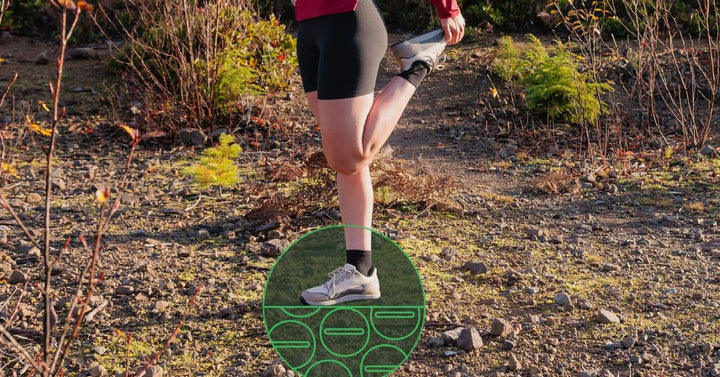




Grounding means being in electrical contact with the earth.
With our Ground Flow System , Bahé shoes help you stay connected on natural ground — even when going barefoot isn’t practical.

The science of grounding
Humans are bioelectrical — our bodies generate and respond to electrical signals. Modern life often puts more insulation between us and natural ground. Grounding is simply restoring electrical contact with the earth on suitable, conductive natural surfaces.

The Earth is part of a natural global electrical system. In atmospheric electricity, the Earth’s surface is typically negative relative to the air above it, while the upper atmosphere is positive by comparison.
Grounding simply means restoring electrical contact with the earth (on suitable, conductive natural surfaces), allowing electrical charge to equalise between your body and the ground.
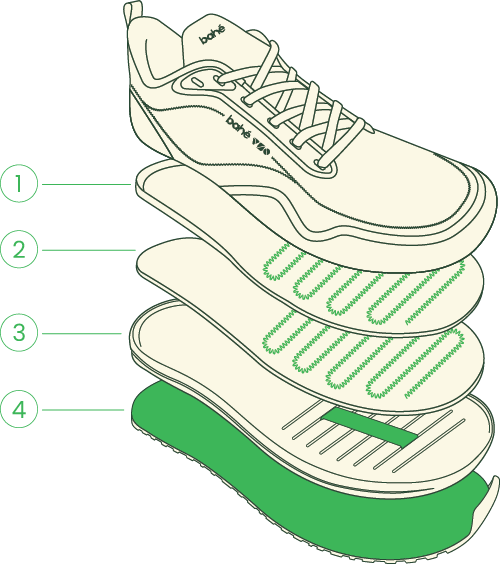
How they work
1 - Conductive stitch on removable insole
2 - Strobel board with conductive stitch
3 - Conductive loop through midsole
4 - Conductive additive in outsole
Conductive in accordance with EN ISO 20347:2022. - Making them certified to have close to zero electrical resistance.
How they work
How they are made
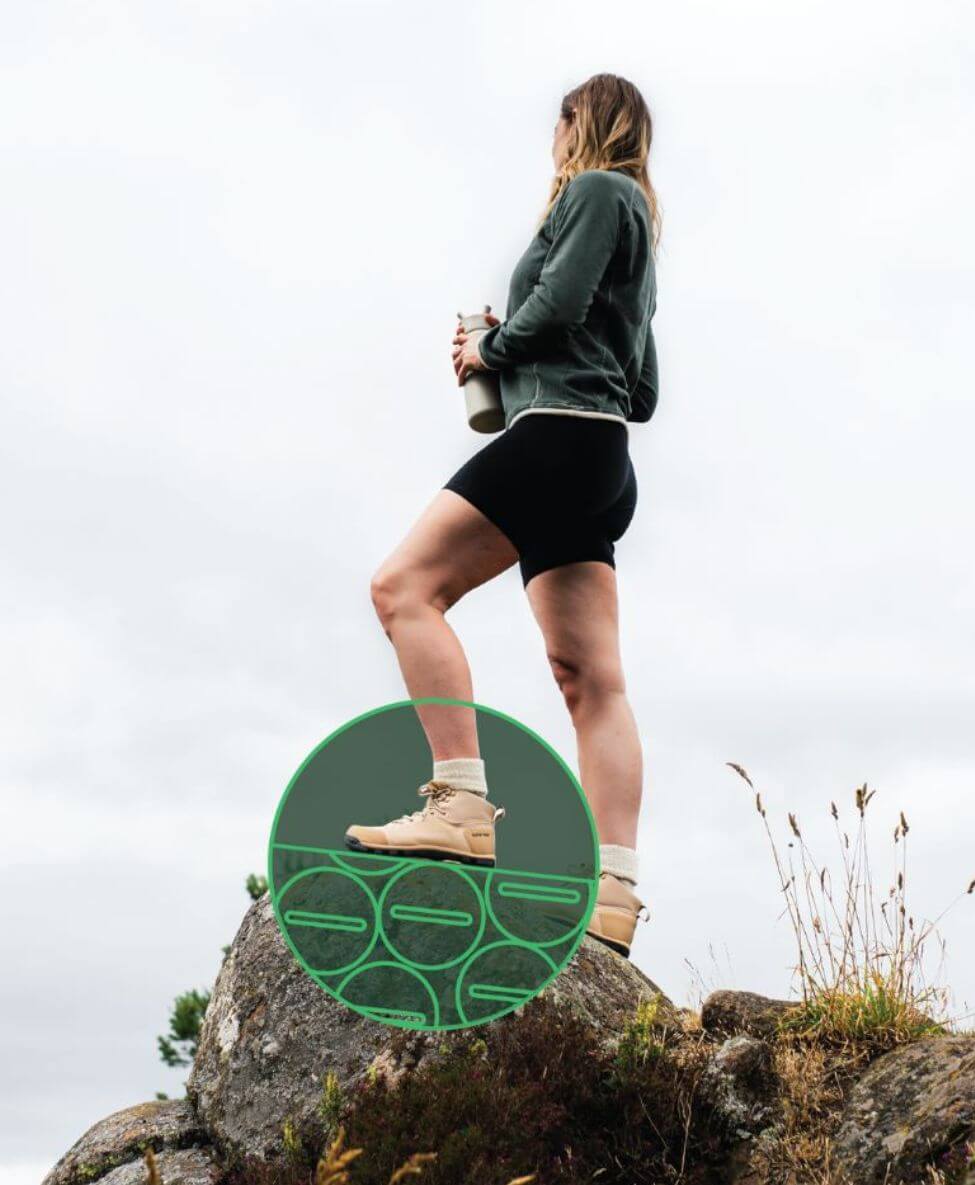
Where can I be grounded?
Grounding opportunities are all around us. It's all about selecting the right surface. When in the countryside you can't go too far wrong, but when running in towns, some tweaks to your route can help maximise your grounding time.
The guide below suggests what surfaces to target and avoid.

Grass

Earth

Gravel

Sand

Concrete

Stone

Synthetic

Asphalt
Grounding FAQs
You’ll know you’re grounded when there’s a real electrical connection between you and the earth (on a grounded surface).
The simplest way to check is with a quick electrical test.
1) Test with a multimeter (body voltage)
A multimeter can show the small electrical voltage your body can pick up from your environment.
Stand or sit on a grounded surface (natural ground is best).
Measure your body voltage (usually by holding the probe).
Then test again while you’re barefoot on the ground or wearing Bahé grounded shoes on the same grounded surface.
If you’re grounded, you’ll typically see your body voltage drop closer to zero (your charge is being equalised).
2) Test with a continuity tester (simple connection check)
A continuity tester checks whether an electrical path exists.
Put one end on a known earth/ground point.
Touch the other end with your hand while you’re barefoot or wearing Bahé grounded shoes on a grounded surface.
If there’s a connection, the tester will indicate continuity (meaning you’re electrically connected to earth).
A quick note on surfaces
Grounding depends on what you’re standing on. Natural surfaces (soil, grass, sand, rock) are usually the easiest. Many indoor floors (and some outdoor surfaces like sealed rubber) won’t create the same connection.
About Bahé’s conductivity
Bahé shoes are built with a conductive pathway and are tested to EN ISO 20347:2022 electrical resistance requirements, meaning they’re engineered to provide very low resistance under the right conditions.
Grounding is an electrical connection, so it can begin as soon as you’re in contact with the earth (or a grounded system) on a grounded surface.
When people notice anything is individual — many treat grounding as a regular habit, not a one-off.
In research, grounding has been explored across:
Single sessions (minutes to around an hour)
Overnight grounding (sleeping grounded)
Daily use over multiple weeks
If you’re curious, start with what’s easy to repeat — even short, consistent time on natural ground can be a good place to begin.
The Ground Flow System is a set of conductive components integrated through the shoe — from the footbed through to the outsole — designed to create a low-resistance path to the earth on suitable natural surfaces. So you can wear your shoes while still supporting an earthing connection, with the same durability and performance you’d expect from your footwear.
Yes — going barefoot on natural ground is the simplest way to explore grounding, and we encourage it whenever it’s comfortable and safe.
Bahé shoes are designed to be an extension of barefoot grounding, not a replacement — so you can stay connected when going barefoot isn’t practical (cold, rough terrain, urban environments) or when you’re training and want protection, grip, and support.
In other words: barefoot when you can, Bahé when you can’t.
Electrons are tiny, negatively charged particles found in all atoms. In many materials (especially metals), they can move from place to place — and that movement is what we call electricity.
In grounding conversations, electrons are often referenced because a conductive connection to the earth is described as a way for charge to equalise between your body and the ground.
In atmospheric electricity, the Earth and the upper atmosphere form a natural “global electric circuit.” On average, the Earth’s surface is typically negative relative to the air above it, while the ionosphere (high up in the atmosphere) is positive by comparison.
This separation of charge is maintained by ongoing activity in the atmosphere — especially storms and lightning — which help keep the system in balance.
In grounding terms, the key idea is simpler: the Earth is a huge conductor and a stable electrical reference. When you have a conductive connection to it (for example, barefoot on natural ground, or through grounding footwear on a suitable surface), your body can equalise electrical charge with the Earth.
Yes. Bahé shoes have a removable insole, so most orthotics can fit easily.
One thing to know: adding an orthotic can interrupt the conductive pathway between your foot and the ground. In that case, you’ll still have a great pair of shoes — you just may not get the same grounding connection.
Half length orthotics will not be a problem, but full length ones will block the Ground Flow System.
However, there is a workaround. If you use conductive tape on your own insole and wrap it around the same area of the insole where our special material is, you can remain grounded in our shoes when on natural surfaces.
For everyday use, conductive footwear isn’t inherently “dangerous” — people have worn naturally conductive materials (like leather soles) for a long time.
The key safety point is context: because conductive shoes are designed to allow electrical connection, they shouldn’t be worn in environments where there’s a risk of electric shock, such as around exposed live electrical parts, damaged wiring, or when doing electrical work.
If you’re ever unsure, treat them like you would going barefoot: avoid contact with anything that could be electrically live, and use appropriate protective footwear for higher-risk settings.