 Duty-free Shipping To EU
Barefoot Shoes, Orthotics And Cushioning: a Podiatrist Answers The Big Questions

Andy Bryant
Podiatrist

We wanted to know what more than two decades of working with feet can teach you about barefoot shoes.
So we spoke to Podiatrist Andy Bryant about how his thinking has evolved over the course of his career - through clinical practice, working with patients, learning from other foot and movement specialists, and questioning some of the more traditional ideas around support and orthotics that he was originally taught.
Along the way, we asked what podiatrists think about barefoot shoes, when orthotics can genuinely be useful, what actually makes a shoe “barefoot”, why cushioning still has a role, and how different people can approach the transition.
Andy is sharing his professional perspective and experience rather than individual medical advice. If you’re dealing with persistent pain, a recent injury or more complex symptoms, it’s worth getting assessed individually.
Question 1. What are podiatrists traditionally taught about footwear, support and orthotics?
Question 2. How has your own thinking about foot health and footwear changed over time?
Question 3. When are orthotics or insoles genuinely useful?
Question 4. What are the limitations of relying on orthotics or supportive footwear long term?
Question 5. How do you define a barefoot shoe?
Question 6. Why can cushioning still be useful in a barefoot shoe?
Question 7. Do you recommend barefoot shoes?
Question 8. Who may need a more gradual or individual approach?
Question 9. How should someone start wearing barefoot shoes?
Question 10. What misconceptions do podiatrists and patients have about barefoot shoes?
We’re definitely taught that shoes should be slightly heeled, stiff around the heel cup, fixed onto the foot, only flex across the metatarsal heads, be stiff between the heel and the metatarsal heads, be wide at the base of the toes rather than at the tips, and have cushioning and support. These are the things traditionally considered to make a good shoe.
The issue is that this often relates back to what we were once taught about the foot: that there is, or can be, this perfect foot shape, and that anything outside it is more likely to get injured. Yet we now know feet are more like noses. They come in all different shapes and sizes, and we can mostly breathe and smell through them just fine. Feet are much the same - they vary hugely, and most still function just fine.
That idea of a “good shoe” was based on this idea of a “good foot”, which is now antiquated. We’re now seeing that the newer, more research-backed theory is that our feet are meant to feel the ground. From feeling the ground, the foot sends a message to our central nervous system, which relays a message back to the foot so it can react to its environment.
So the traditional idea of a good shoe doesn’t make as much sense anymore. It’s stiff, only allowing movement at the metatarsophalangeal joints; it’s stiff around the heel; and it’s cushioned, which reduces the foot’s ability to feel. We’re taught that cushioning is good, but we know differently now.
Support is supposedly good too, but if you support something over and over again, it doesn’t need to do the work itself. It’s that old “if you don’t use it, you lose it” analogy.
Orthotics came about because we had these ideas about the foot needing to move or sit in a certain way, especially the static foot. You’d look at a foot and go, “Oh, that’s a certain structure, and we need to move it into this other structure.” So we would use an orthotic to change the shape of the foot. That’s what I was taught.
I think we’re now taught more that orthotics change force, and they do change force in different areas. So you can use them for certain periods of time while you’re unloading a structure that might be sore. But there’s still this idea that there’s something inherently wrong with your foot that needs fixing with the orthotic.
I think we can move away from that and understand that someone may have overloaded a tissue through activity, lifestyle factors or any number of things within that biopsychosocial model. If we’re just looking at biomechanics, it’s a very small subset of it. I don’t think we need to use orthotics to the level that we do.
A big part of what we’re taught at university is that pain is the thing we’re measuring. You know that visual analogue pain scale? I don’t even ask people what their pain is on the scale. They often tell me anyway. Obviously I want to know where their pain is, but when pain becomes the primary measure, you’re going to support it, cushion it and use orthotics because those things stop the foot moving and take load away from the painful area.
Personally, I’m more likely to have function as the goal. If someone wants to build up to walking five kilometres again, let’s start them walking. Pain might stay the same for a while, but if function is improving, we’re seeing a positive change. Pain is so complex.
I really focus on function, and I don’t think the podiatry schools are doing that just yet. I think they’re still focusing on pain. That’s why we see people in an orthotic and a Hoka, which is like putting someone in a moon boot. We even see people with plantar heel pain in a moon boot because they’re so desperate to get someone out of pain rather than worrying about function. A Hoka and an orthotic, or a moon boot, can be such a dysfunctional thing.
If we educate someone well and reassure them about their injury, we’re more likely to get them on board with doing rehab and putting up with a little bit of pain along the way. If we tell someone it’s okay to go for a walk even if it gets a little more painful in the short term, we can often take a much more proactive approach.
Obviously, you don’t want to do any long-term damage, and it depends on the injury. But if we focus on function rather than pain alone, we can start moving forward. People leave my consultation saying, “Oh, there’s hope,” and they often feel better simply because we’ve talked about what pain is, reassured them about their injury and helped them understand it.
That’s where the focus should be: on function rather than pain, which is where the focus has traditionally been.
I finished university in 2000, and I’d done an honours year where we looked at how stiffening the big toe affected the ankle, the knee and the other joints. We tried to stiffen the big toe with tape and then watched people with dots all over them to see what happened at the knee. The assumption was that it would increase knee flexion and therefore, if someone had a stiff big toe, they might be more likely to get patellofemoral pain.
Through that year I was also teaching first- and second-year undergraduate students in the clinic, and I really enjoyed teaching and educating people. I thought, “Maybe I’ll go into the teaching side of this.” But I also understood that it would be better if I had some experience, so I got a job as a podiatrist and really enjoyed that even more. It was probably more financially viable too, so I went into practice rather than down the teaching route.
I’ve now come full circle to teaching and educating more. But every consultation is an opportunity to teach someone who doesn’t know about foot health and help them on that journey, so I’ve always had that opportunity.
I went into my own private practice with a business partner in 2001, and we had our own little lab, which was unusual. We would take a cast of the foot - now people are scanning feet for orthotics - and I’d make the orthotic myself. I used to joke that I didn’t make many orthotics because spending three or four hours on each one meant my workload outside clinical time was going to be huge. So I really did have a reputation for not over-prescribing, even all the way back then.
Making them myself also gave me a wonderful understanding of how and why orthotics might work. Interestingly, if you went to an optometrist with an eye condition, I’m pretty sure you’d get the same personalised script if you went to another optometrist. But when you go to a podiatrist, there’s an art to making an orthotic.
I saw this because my business partner would make one, and it wouldn’t be the same orthotic I would have made for that client. Now I see it because people come in with six different pairs of orthotics that are all different for the same foot.
So if this is a customised approach, it’s customised towards what the podiatrist does, not necessarily towards the client in front of you. That’s an issue with orthotic manufacturing that I probably saw very early on. There’s still a lack of understanding around exactly how they work, which speaks to that as well. The science behind it is not great.
My practice grew, and I would see a lot of normal podiatry - nails and calluses, corns, ingrown toenails - as well as some biomechanics. But once you’re good at the basic stuff, your book fills up with it. You end up doing less biomechanics, and then when you do see it, you tend to be doing the same things because you’re seeing less of it. It got a bit tedious.
I was probably looking outside my career for enjoyment, and I was into cycling, golf and things like that. I actually had four concussions in two years from falling off my bike, so I had to quit cycling. For some reason, I went to a yoga class two or three months later, and I’d also started running again.
I had a running background, but I kept getting injured. Orthotics didn’t help me. I just kept getting stress fractures. So I’d quit running years earlier and taken up cycling.
Then I took up yoga, started running again and started going to the gym for the first time in my life. There was someone at the gym training barefoot, and I thought, “That’s a bit weird,” because we’d been told as podiatrists that we couldn’t train the feet, just like we can’t train eyes. The muscles are too small. You don’t train the foot muscles; you just need to support them.
I remember the FiveFingers running boom around 2010 and people coming in saying, “Can I run in these?” And I’d be like, “Oh no, you can’t. You can’t change your foot. Your foot needs this. You need to stay in those shoes.” It’s a bit embarrassing now, but we all grow and move on.
By around 2016 or 2017, I was 16 or 17 years into my career. I was going to yoga regularly, and they were giving me cues on how to train and change the shape of my feet. I was thinking, “Wow, my feet are getting stronger.”
I was still in traditional shoes, still wearing orthotics and still wearing a heeled, almost dressy boot every day to work. I remember going for a run - I’d started running in my ASICS - and then I’d heard about changing running technique and things like that. I went for a run in a pair of casual Adidas shoes, which you can imagine were pretty flat and flexible, and my calves just completely lit up.
I started exploring all these different things and came across The Foot Collective. I remember listening to Nick explain things on his podcast, and it was really helpful. Then I found Gait Happens as well and did one of their courses when they came out to Australia.
That was a really powerful time around 2018 and 2019. I also found it increasingly difficult knowing someone could book into the same practice and receive a very different treatment protocol depending on who they saw. There were a few things going on, and I left that practice at the end of 2019 or start of 2020.
I started reaching out to health practitioners in my area who could see through my Instagram that I rehabbed feet like we would rehab the rest of the body. That leads me to the last five or six years, where I’ve been refining the art of this and getting back to teaching, both my clients and other people through The Foot Collective and courses.
I think we could summarise this by saying that I learned through my own experiences of changing my own feet.
I also had children whom I put in orthotics from when they were three or four because they had feet like their mother’s, which are low-arched and their heels tip in. We’re taught in podiatry that that’s going to be a problem and, if you straighten it, that’s going to fix things.
So I put my kids in orthotics from when they were three or four until they were seven and nine. Then we took them out and put them in barefoot shoes. They haven’t looked back.
Their feet still don’t look textbook, but what is textbook? We now know that a low arch and everted heel at rest doesn’t matter. My 19-year-old daughter can run 10 kilometres in a barefoot shoe. My children are highly functional with feet that don’t look textbook.
I remember clearly, probably 15 years ago, seeing someone with that textbook foot - the foot that looked just right - who was still injured. I was really flummoxed. This foot is perfect biomechanically, so why are they injured?
We really didn’t understand the biopsychosocial model of pain, or overuse, or lack of capacity. Over the last five or six years, I’ve learned that there are so many factors involved in someone being in pain. Often, it’s to do with lifestyle factors.
The foot needs to be loaded to be healthy. Often it gets sore when it’s not loaded well or not loaded enough. If we find where it’s at in terms of mobility and strength, and then slowly build up its capacity in a graduated way, we see a foot that’s more able to cope with the rigours of what that person wants to do with their life over the long term.
It doesn’t mean they’re not going to get injured. There are so many other factors that cause pain and injury. But at least we’re ticking that biomechanics box by having someone as resilient as possible because they’ve worked on their mobility and capacity and allowed their foot to do its natural thing.
In my practice, I have this idea that I’m always going to meet someone where they’re at. Often people come to me with orthotics and they’re quite used to them, and they don’t even mind them. Removing them could be a goal of theirs, or it might not be. If it’s not, then I’m probably not going to remove them. But if I educate them well, often they might want to.
Generally speaking, I hardly ever prescribe them. If I do, it’s more likely to be for something congenital or hereditary.
For example, I look after a hypermobile child whose arch doesn’t easily get out of pronation and into supination, so we use an insole up against the skin to create some proprioception and encourage that arch to activate. It’s not limiting her movement. If anything, it might be encouraging it. She doesn’t have pain, but we’re trying to encourage that movement of the foot.
Or if someone has had a club foot and surgery, they may still need an orthotic to change the way the weight flows around. In situations like that, they can be really useful, and we’re lucky to have them in our toolbox.
Then there are acute injuries. For example, with a tibialis posterior injury where the foot is really low-arched and struggling to get out of that position, we can use the force of an orthotic to take some load off the tibialis posterior while gradually increasing movement and capacity in the muscle.
There are also situations where one joint is stiff and the joints around it are having to work harder than their usual capacity. An orthotic might help in the short or medium term during periods where you’re asking more of the foot. That’s generally how I would use them in the short to medium term.
The longer-term situations are more likely to be congenital, hereditary or following a serious injury. I had someone in today who had an ankle injury 20 years ago, which probably led to changed mechanics. Her hip started giving her issues around 10 years ago, then she had a hip replacement, which changed her leg-length difference.
Nearly everyone has some leg-length difference and is totally fine because they’ve grown up with it and their body has adapted. But when you impose something like a traumatic ankle injury, which then leads to a hip issue and another structural change, the body isn’t used to it and can struggle to adapt.
In a situation like that, you might use a permanent insole on the shorter side to lift it a little and change the load. That’s a good example of an injury meaning we might need some type of insole.
So they can be genuinely useful, and we’re really lucky to have them in our toolkit. But unfortunately, they’re also very financially viable for businesses.
People are always trying to do better. If there’s something wrong with me, I need to fix it. If my kid has low arches, I need to make sure they don’t have problems in the future.
And unfortunately - and this is me being a bit negative towards our profession - whether people don’t know better, like I didn’t, they can end up telling people things about their foot structure that mean they need an orthotic ongoing.
I know this because I deal with it every day. People come in to see me with preconceived ideas about their feet, whether it’s their auntie, uncle, the shoe shop or their last podiatrist or physio saying there’s something wrong with their foot and they need this permanently.
And that is rarely the case.
Orthotics definitely can be used in the short to medium term for conditions that require offloading, and longer term for congenital or hereditary issues, or after significant injuries or surgery. In those situations, they may be part of a long-term solution.
However, for most foot conditions, they’re not required long term. If they are used, I generally see them as something for a shorter period of time.
When we become reliant on an orthotic, it can limit the shoes we can wear. It can also build into this idea that there’s something inherently wrong with our feet simply because of their shape or the way they move.
Our feet are all different and move differently anatomically. There’s no such thing as the perfect foot. So I think it’s important that our brains can realise our feet are just fine the way they are, rather than becoming reliant on an orthotic.
There’s also the physiological aspect, especially with some orthotics that are very stiff and hard. If they’re crossing a joint that’s meant to move, that joint won’t move as freely, and therefore the muscles crossing that joint may not be as strong or supple as they otherwise might have been.
So there’s this idea that we may be restricting the way the foot would naturally move without the orthotic. The research is thin on the ground when it comes to how orthotics might weaken feet or change the way feet move. But it’s common sense that if you put something stiff across a joint, it’s going to change how that joint moves and have an effect on the joint and the tissues crossing it.
That’s one of the limitations of using them long term, I think. If someone is very accustomed to using them, though, we definitely shouldn’t be reducing their use too quickly.
If we are going to reduce them, we need to make sure the foot is strong enough and mobile enough to cope with that change. That’s where rehab plans come in.
I also think that when we wear a shoe that allows for a straight big toe, it can help reduce the need for an orthotic and the amount of support within it, because a straight big toe acts as a blocker for pronation. It allows the foot to pronate, but when you get to the straight big toe, it helps the foot get out of that position into supination.
If the big toe is pushed sideways, that might be one reason why we need more support in the foot in the form of an orthotic. So when we have room to keep the big toe straight and use it in a properly wide shoe, I’ve found we don’t need as much orthotic support.
Also, when we go to a shoe with less heel-to-toe drop, we have fewer pronatory moments. With a higher heel-to-toe drop, we’re more likely to put the foot into pronation. So in a zero-drop shoe there are fewer pronatory moments and, therefore, less support may be needed.
The way I help someone transition out of an orthotic is to put the orthotic into a flatter shoe that allows them to use their big toe. Then we slowly reduce either the amount of time they use the orthotic or the strength of the orthotic itself, which a skilled podiatrist can do by thinning the shell.
And we go from there.
Barefoot shoes, natural footwear or minimalist footwear exist on a spectrum, with being barefoot at one end and being in a Hoka - a thick-soled, rocker-soled shoe - at the other.
I would consider “barefoot shoe”, “minimal shoe” and “natural footwear” terms that can be bandied around, and I think they all pretty much mean the same thing. It starts with certain criteria.
The Foot Collective have coined these the Five Fs: foot-shaped, fixed, flat, flexible and feel.
The shape of the shoe’s toe box must be foot-shaped. By that, I mean the big toe needs to be able to stay straight and the toes need enough room to splay within the shoe, whereas most conventional shoes aren’t foot-shaped.
This is integral to a barefoot shoe. As soon as the shoe isn’t foot-shaped, it can’t really sit on that spectrum. It can’t be labelled minimalist, barefoot or natural footwear.
Foot shape is super important for many reasons. Toes don’t need to be splayed all the time, but they need to have the ability to splay. And we need to be able to use our big toe, which means allowing it to stay straight.
So defining a barefoot shoe starts with it being foot-shaped.
The second is that it should be fixed. For natural human movement to occur, a shoe should stay on the foot without the foot having to do something different to hold it there.
“Fixed” might mean a strap around the back, lacing or something else that keeps the shoe secure, so when the foot lifts off the ground we don’t have to claw our toes or turn our hips out to keep it on.
This is a must. If it’s going to tick the box for barefoot, minimalist or natural footwear, it needs to be fixed to the foot.
The third of the Five Fs is that the shoe should be flat from heel to toe. This is what we call zero-drop.
That might mean it has one centimetre of cushioning under the heel and one centimetre under the forefoot. It can still have cushioning and be a flat or zero-drop shoe. This allows our posture to be the way it’s naturally intended to be, without the shoe imposing a heel-to-toe drop on it.
There are two other aspects of “flat”, though. The first is toe spring. If you look at a conventional shoe, often the front of the shoe peels up and pulls the toes off the ground.
That’s helping the foot push off the ground, and in most situations it’s an unnecessary thing for the foot to need. If a shoe has significant toe spring, I wouldn’t really consider it a barefoot shoe, although there can be different amounts of toe spring and a small amount might be helpful for somebody depending on where they are.
The other aspect of flat is arch support. That’s obviously a big topic, as to whether our arches need support. But inherently, our arches are meant to be mobile, adaptable and strong.
If we support something in the human body, we can decrease its mobility, strength and adaptability. So I wouldn’t expect a barefoot shoe to have built-in arch support.
Our foot has 33 joints, and those joints aren’t there just for the sake of it. They’re there because the foot is meant to move. Some parts of the foot move more than others, and the joints reflect that.
Traditionally, shoes have only flexed across the metatarsophalangeal joints, which is where the joints move the most. But that means the joints of the rearfoot and midfoot miss out on movement that gives our body feedback about how we’re moving through our environment.
A barefoot shoe should therefore allow some flexibility so the joints of the foot can move according to how the body is moving and what the environment is doing underneath it.
This is also on a spectrum. Some shoes are super-flexible, some are moderately flexible and some are really stiff. There isn’t one precise point where you can say, “Now this is a barefoot shoe because it has this much flexibility.”
That depends on where somebody is, what they’re accustomed to and where they want to get to. Maybe you need a stiffer shoe to help through a certain injury. But generally, we’re moving people along the spectrum towards less stiffness and more flexibility, so the foot can move according to the way it’s designed to, the way the body is moving and the environment.
Then feel is a huge one. We sort of tack this on at the end because it’s probably the hardest thing to get used to, but it shouldn’t be tacked on - it’s possibly the most important.
When we’re walking, the only thing physically in contact with our environment is the sole of our foot. It’s telling us so much about that environment, so it’s super-important that our feet get to feel.
It’s difficult for people because they’re often so accustomed to thick, cushioned soles. Over time, we can lose some of that ability to have strong, adaptable feet that cope comfortably with deep pressure and different surfaces.
So it’s important to build someone’s ability to feel the ground and use a shoe that allows some feeling. You still want protection from hot and cold temperatures and sharp things, but feel is really where the foot’s function is at its best.
The foot reacts to the environment and sends messages back to our central nervous system, which in turn sends information back to the foot about how to respond in real time. A barefoot shoe should allow that to happen to some degree, depending on where someone is in their journey.
As I discussed in the last answer, being able to feel the ground is probably the most difficult thing for someone to become accustomed to because we’re so used to having less ground feel.
Cushioning can still be useful in a barefoot shoe because it helps meet people where they’re at.
If someone is accustomed to a big ASICS or Nike - or whatever brand - with lots of cushioning, and you put them into a very thin shoe, their body and feet aren’t accustomed to that and will most likely feel quite uncomfortable.
Whereas, if we move into a shoe that has the other aspects of a barefoot shoe - being wide, fixed, semi-flexible and zero-drop - we can still put some cushioning in. You get the benefits of those other aspects of a barefoot shoe while helping someone get used to feeling the ground a little more, without doing too much too soon.
Fortunately, we have shoe brands that make various levels of cushioning, so we can use those to meet people where they’re at. I have a lot of clients who end up there. They don’t necessarily want to go into less shoe, but they’re still able to feel the ground more, so we’re still tapping into better foot health. They might be perfectly happy in that realm.
It also needs to be said that when we cushion our feet for a long period of time, the cushioning of the shoe does some of the shock absorption that the foot is meant to be doing. The foot can forget how, or become detrained from being a shock absorber.
If we go into too little shoe, with too little cushioning, then a foot that isn’t prepared to be the shock absorber is suddenly having to take a lot more shock and ground reaction. That can create problems too. So it’s important that we don’t rush that process.
The foot is the ultimate shock absorber. When we use our feet to absorb shock, it can reduce the amount of load travelling through joints and structures further up, such as the knees, hips and back. But if the foot isn’t accustomed to coping with that load, then it can take a lot itself and structures further up may take more too.
Having a cushioned shoe decreases the load on the foot, and the foot gets accustomed to that, so we shouldn’t rush the process of decreasing cushioning.
There’s also an argument that we aren’t naturally on hard, flat surfaces. I think you can split that into two.
We are naturally on hard surfaces. Humans have always walked on rocks and well-trodden paths. Our foot should be able to cope with hard surfaces, but we can become detrained from doing it.
The flatness is different. Natural surfaces are rarely as consistently flat as many of the man-made surfaces we have now. But even on hard, flat surfaces, the way we move changes with every step.
The only way it would really be the same every time is probably if you were on a treadmill staring at exactly the same point. Even then, if you turn your head, look up or down, look at the screen in front of you or change how you’re moving, your foot reacts to that and moves differently.
So the stress is not as repetitive as we think. In fact, the more cushioning and stiffness we put into a shoe, the more repetitive movement can become because the shoe removes some of that nuance.
If we’re walking on the street or pavement and moving around people or objects, crossing roads, stepping up and down kerbs and looking around, our foot is doing something different all the time. If we wear a shoe that allows the foot to respond differently as we move, there can be less repetition through exactly the same structures over and over again.
So yes, there’s nuance to this conversation.
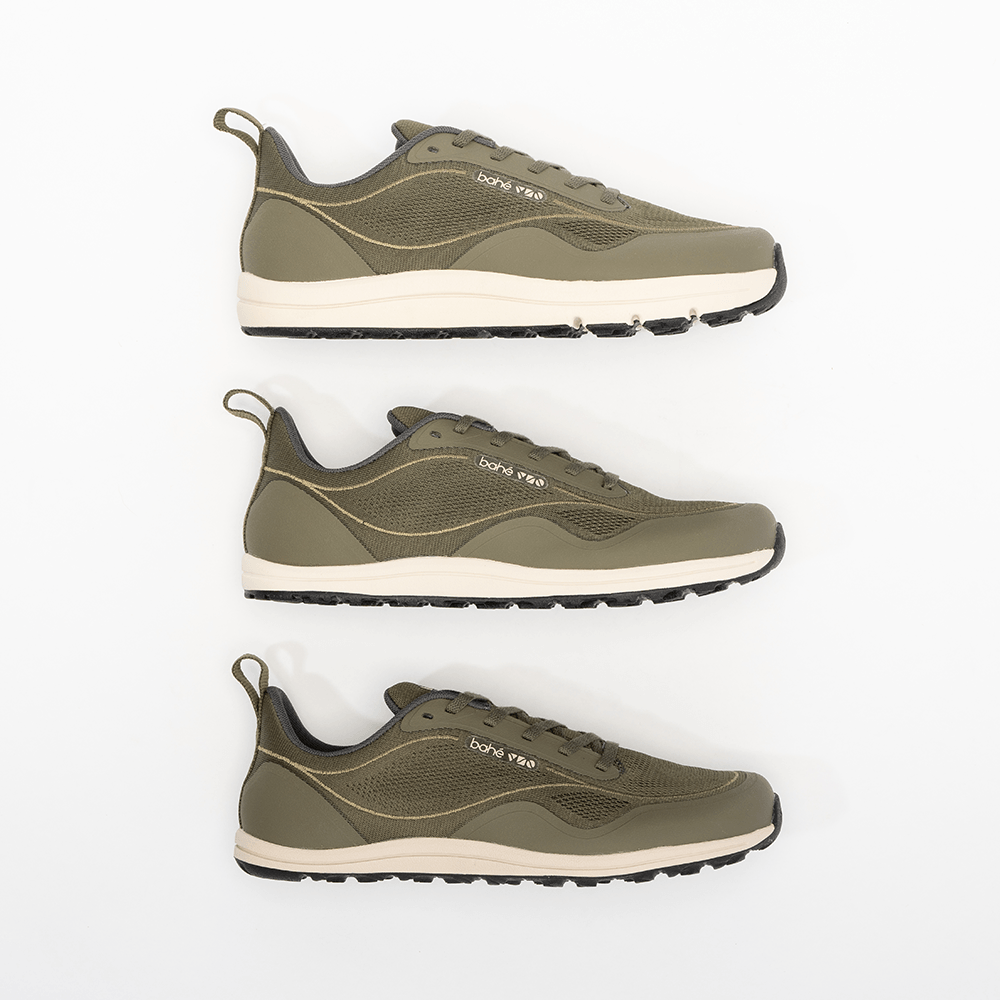
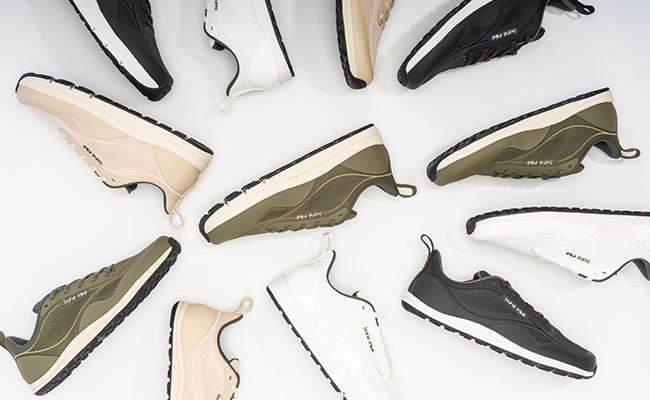
Andy describes cushioning as one of the variables that can change depending on what someone is used to and where they are in their transition. Bahé Modes use three different sole cushioning levels, where available, while keeping the barefoot-fit principles of the relevant shoe. Endurance is the most cushioned option, Adapt sits in the middle and Flex provides the least cushioning and most ground feel.
Yes, I do recommend barefoot shoes, but the type of shoe and the way it is introduced matter a lot.
One non-negotiable for me when recommending shoes is that the shoe is foot-shaped. If I have a client come to me who isn’t wearing foot-shaped shoes, the first thing they need to do is start wearing them.
In ten years of practising this way, I’ve only seen two people who have struggled with the change into a foot-shaped shoe, for very nuanced reasons. So that is few and far between.
This is important because a foot-shaped shoe allows the foot to move naturally, to be stable, strong and supple, and to do all the things it is meant to do. So this is non-negotiable.
Often, my work is based around rehabilitation, lifestyle changes and things people need to do to or for their feet. But the simplest thing is just to let the foot have space to move.
If you’re doing all these other things without changing your footwear, it’s counterproductive. You’re working against yourself and having to do work on your feet that you shouldn’t necessarily need to do, because wearing a foot-shaped shoe makes all the difference.
So yes, I recommend barefoot shoes a lot. Nearly everyone is recommended a barefoot shoe, but specifically a foot-shaped shoe.
The nuance depends on where they’re at in terms of stiffness, heel-to-toe drop and cushioning. Those three factors become more of a concern if someone is dealing with a certain injury.
For example, if someone has an injury that is going to be aggravated by moving from a heel-to-toe drop to flat, and they’ve been wearing a higher heel in their shoes - whether that’s a trainer or even a high heel - changing them into a very flat shoe might aggravate the issue in the short term.
Or if someone is accustomed to a stiff orthotic in a stiff shoe and I put them into a very flexible shoe without their orthotic, they’re going to struggle with that increased amount of movement in their foot. So we need to meet them where they’re at.
Fortunately, there are shoes that accommodate all these things. Again, if someone is struggling with foot pain that might require or be helped by some cushioning, putting them into a very thin shoe wouldn’t be appropriate.
So those are three examples, but the non-negotiable is definitely that the shoe is foot-shaped. And yes, I definitely recommend barefoot shoes, but there’s a lot of nuance to this.
As I mentioned in my last answer, going foot-shaped is a no-brainer and a non-negotiable for me.
However, if someone has an acute or chronic injury, it’s more about assessing where they’re at, what they’re accustomed to and then slowly moving them down the spectrum towards wearing less shoe, while building their capacity to become more mobile and strong.
This can take many shapes and forms. I think it’s even more important to assess where someone is in terms of how they’re living the rest of their life.
Are they sleeping well? Are they eating well? Are they managing their stress levels? Are they overweight? I also want to know someone’s movement practices and history.
Take a runner, for example, who only runs and otherwise sits at a desk without doing any other exercise. That would be an asterisk or red flag for me against moving too quickly, because we see issues when somebody is one-dimensional - or zero-dimensional - in their movement habits.
Those people generally need to take the transition a lot more slowly than someone with a more diverse movement practice. That could simply mean going to a yoga class twice a week.
If somebody is injured, then obviously we’re going to take the transition slowly. But there are still some things they can change, such as moving into a foot-shaped shoe.
They might have an orthotic, in which case we can put the orthotic into that foot-shaped shoe. Or they might be used to a very stiff shoe, so we decrease the stiffness a little.
If they’re not injured or in pain, then it becomes more reliant on those other aspects of their life, because I don’t want to create pain.
This is relevant to a footwear company like Bahé, or any of the barefoot-shoe companies, because people are coming to this to improve their foot health without necessarily having had injuries.
It’s important that they understand it’s not just about their feet. It’s about the way they live their whole life. Looking after all those other things is going to help their feet as well.
We’re often quite defensive about this: “Oh, you’ve got to be careful. You’ve got to be careful.”
But if somebody is habitually barefoot around the home, spends hours a day barefoot during summer, has a movement-rich and varied lifestyle and is looking after themselves, they can make the change into barefoot shoes very, very quickly. It doesn’t need to be gradual for that individual, and they’ll thrive very quickly.
But if someone hasn’t been looking after themselves well, has a history of injury or has current pain, then they need to assess themselves and reflect on where they’re at.
This can be done in various ways.
If someone is really keen to get into a very minimalist shoe, they might buy that shoe and initially wear it only for certain activities, such as walking around at home or going out for coffee with friends.
They might not wear it to the local shopping centre, where they’re going to spend three hours standing on very hard, flat surfaces. They might start wearing it to the gym instead.
You might think, “Why would you wear it to the gym? That’s a high-load environment.” Yes, it is, but it’s a high-load environment where you’re thinking very specifically about how you’re moving. You’re moving in a very structured way, usually for a short period of time, so that can work really well.
You could then slowly increase the time as your foot begins to tolerate a shoe that has far less in it. That’s one way to do it: buy the more minimal shoe and slowly increase the time spent wearing it.
Alternatively, you could buy a shoe that’s closer to what you’re already wearing. It would be foot-shaped, but might be a bit stiffer and more cushioned.
You could transition into wearing that shoe more of the time relatively quickly, wear it for a while and then progress to the next level down, with less cushioning and more flexibility. You could wear that one for a while, and so on.
It could also be activity-related. You might wear a foot-shaped but more heavily cushioned and less flexible shoe for running if you’re accustomed to running in something even more substantial. But you might do some daily chores or go to the gym in less shoe.
There are different ways of doing this, and there’s no perfect way. The key is to take it gradually, be really in tune with what your feet are telling you and not rush it.
It’s also about being well prepared. I often see people who have worn barefoot shoes for a big hike and then say, “I got caught out.” So it’s about not being caught out without a backup shoe if you think there could be an issue.
Mostly, moving to foot-shaped footwear is a no-brainer. With the other features, it’s about identifying where you’re currently at and slowly moving down that spectrum.
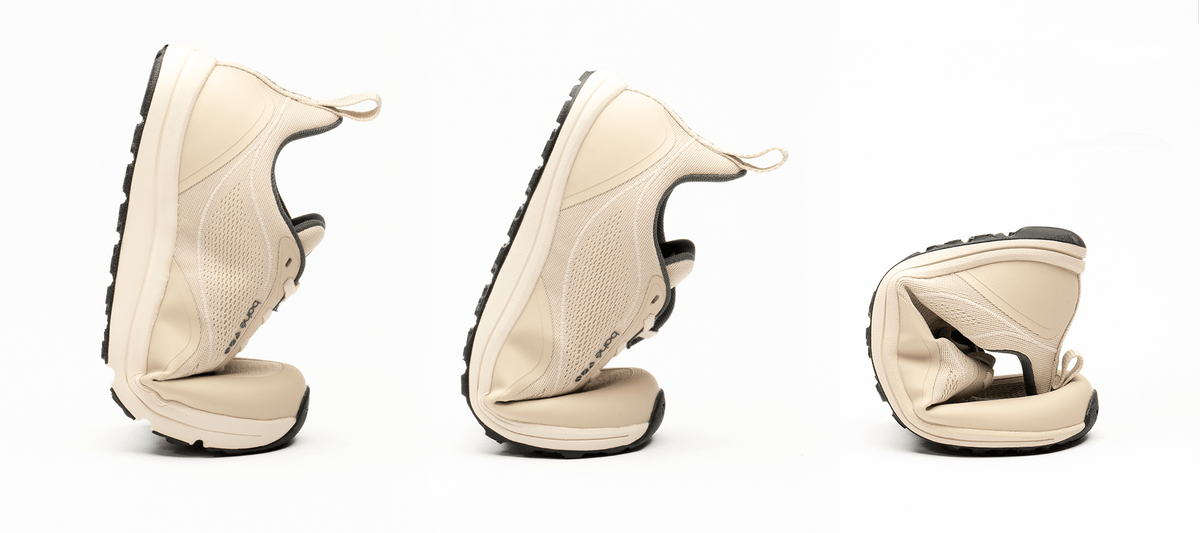
Bahé Modes can be useful here. Rather than changing every feature of the shoe at once, the different cushioning levels allow people to choose a more cushioned or more minimal starting point while keeping the barefoot-fit principles of the relevant model.
This is definitely a two-part answer.
The biggest misconception podiatrists have about barefoot shoes is that we can’t do it - that our feet aren’t up to it and barefoot shoes are going to cause problems.
In my practice, barefoot shoes are a huge part of the solution to people’s foot problems, but most podiatrists think they’re a big no. I guess that’s what I’m trying to change by educating health practitioners that barefoot shoes can be a big part of the long-term solution.
So the biggest misconception among podiatrists is that you simply can’t do it. I think this comes from the idea that your feet are faulty, not up to it or not strong enough - and that they can’t change to become strong enough.
Some of the biggest misconceptions patients have about barefoot shoes are that they’re dangerous; that they’re ugly and wide, because if they’re wide they must be ugly; that they’re all FiveFingers shoes; that they’re going to be uncomfortable; and that they’re all thin, flexible and unsupportive.
They don’t understand that there’s a massive spectrum and that it’s about finding the shoe that matches your foot best. You just need to be able to access that shoe.
I like the idea that finding your barefoot shoe is like finding the ultimate partner for your foot, allowing it to move in the way it was designed - or grew - to move. It’s the ultimate synchronicity of a shoe and foot working together.
It’s simply about finding the shoe that suits your foot best.
There isn’t one podiatrist view on barefoot shoes, and Andy is clear that his own position has changed significantly over his career. Today, he recommends barefoot shoes to most of the people he sees, with foot-shaped footwear as his non-negotiable starting point.
Where he sees more variation is in everything around that foundation. Cushioning, flexibility, heel-to-toe drop and the continued use of an orthotic can all depend on the person, their injury history, what they are currently used to and how they move in the rest of their life.
So Andy’s position is strongly in favour of allowing the foot more room to move and function naturally, without assuming that everyone needs the thinnest or most flexible shoe from day one.
Andy Bryant has developed his view on functional feet over more than two decades as a Podiatrist - from making orthotics himself and working within traditional ideas about support, to questioning those ideas through clinical practice, ongoing learning with other foot and movement specialists, his own experience, and seeing how patients responded when their feet were given more opportunity to move and adapt.
That experience has led him to a clear position: foot-shaped footwear and natural movement should play a much bigger role in how we think about foot health. Orthotics, cushioning and stiffness can still be useful, but as tools for particular people and situations rather than the automatic starting point.
For Andy, the aim is ultimately functional feet - feet that can move, feel, adapt and become more capable over time.





Alert me via email when this size/colour becomes available


Leave a comment