
Understanding Barefoot Shoes: Minimalist, Zero-Drop and Cushioned - What’s the Difference?

Alex Ward
Co-founder and Designer

The language around barefoot shoes can be confusing because terms such as “minimalist”, “zero-drop” and “barefoot” are sometimes used interchangeably, but really refer to subtly different concepts. This blog post dives into the details so you can understand this kind of footwear better.
Zero-drop means there is no difference between the height of the heel and the forefoot, so the foot sits on a level platform. Minimalist usually describes a shoe with less cushioning and structure, a lower overall sole and more ground feel. Barefoot shoes bring several qualities together, including a foot-shaped toe box, secure fastening, zero-drop design and flexibility, while the amount of cushioning and ground feel can vary.
Research suggests that minimalist footwear may influence intrinsic foot-muscle strength and arch structure, although results vary according to the footwear, activity, participants and length of exposure studied (Miller et al., 2014).
This guide explains how these common footwear terms differ, which barefoot-shoe features we see as fundamental and where personal preference, experience and activity should shape your choice.
Interestingly, a 2015 study led by Jean-François Esculier brought together 42 international experts to agree a definition of minimalist footwear and create a way of rating how minimal a shoe is.
The final Minimalist Index looked at five characteristics: weight, flexibility, heel-to-toe drop, stack height and the presence of motion-control or stability technologies. The experts also discussed anatomical fit and agreed that a wide toe box should allow the forefoot to spread naturally during movement. However, toe-box shape was not included as a scored part of the index because, in their view fit depends on the relationship between the shoe and the individual foot, making it harder to assess consistently across different models (Esculier et al., 2015).
At Bahé, we agree with most of those minimalist principles, but we make a clearer distinction between minimalist and barefoot footwear. In our view, a genuinely barefoot shoe must respect the natural shape of the foot, particularly through the forefoot and toes. A shoe may be light, flexible and thin, but if it narrows into a conventional tapered toe box, we would not consider it fully barefoot.
We also take a different view of cushioning and ground feel. Barefoot footwear does not have to mean an extremely thin sole. The right level of cushioning should depend on the wearer’s current foot strength, their experience in barefoot shoes and the activity they plan to use them for. Someone running longer distances may make a different choice from someone strength training or walking on softer ground.
There is one smaller but important detail too: the shoe should be fixed securely to the foot. If it slips at the heel or requires the toes to grip just to keep it attached, the foot is having to compensate for the footwear rather than moving freely within it.
These ideas form the basis of the Bahé Barefoot Shoes Explained framework, which looks at five practical design features:
Together, these Five Fs offer a practical way to assess what a shoe is designed to do and how it may affect the way your foot moves.

What it means in the shoe
A foot-shaped shoe follows the natural outline of the forefoot rather than narrowing sharply towards the toes. The shoe needs enough width and depth for the toes to sit comfortably without being compressed.
It is important to understand that “foot-shaped” is different from “wide”. Many shoes are marketed as wide but still taper through the toe area. They may offer more overall volume without allowing the toes to align and spread naturally.
What it means for your body
Your toes contribute throughout walking and running. They help the foot adapt as it meets the ground, support balance as your weight moves forwards and contribute as you push away into the next step.
A foot-shaped toe box gives them room to spread and move through these parts of the gait cycle. Toe-box shape and volume can also influence pressure around the forefoot, which is why the outline of the shoe matters alongside its labelled width (Branthwaite, Chockalingam and Greenhalgh, 2013).
A shoe can have a very thin sole while still tapering at the front. It may provide plenty of ground feel but continue to restrict the toes. For barefoot footwear, natural foot shape is more fundamental than sole thickness alone.
Patrick Gilbert, Physical Therapist and Athletic Trainer for the Indiana Pacers NBA team explains that “when the toes have room to spread naturally, they can contribute more effectively to balance, weight distribution and propulsion. That is why the shape of the shoe can matter just as much as how thin or flexible its sole is. Our shoes should mirror the shape of our feet, not the other way around”
What it means in the shoe
The shoe is held securely around the heel and midfoot. Laces, straps or another fastening system should prevent excessive movement inside the shoe without creating uncomfortable pressure.
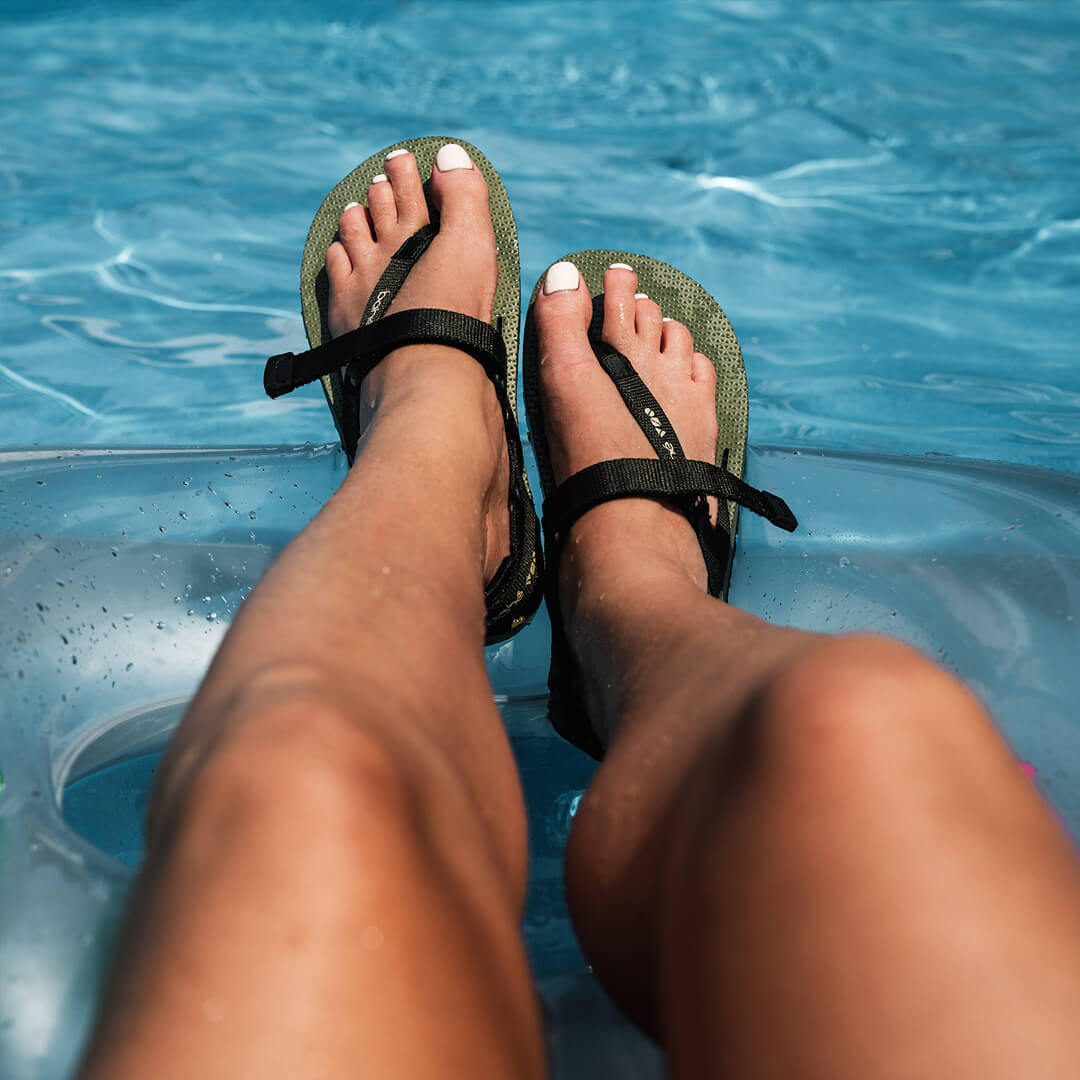
That may sound obvious, as most shoes are designed to stay on the foot. It is worth including because flip-flops and loose sandals are sometimes described as barefoot footwear. Without secure heel hold, the toes may curl or grip to keep the shoe in place. Even with our sandals, we’re conscious of designing them to have a secure heel hold so you toes do not need to grip to hold the sandal in place.
What it means for your body
A secure fastening allows your foot and the shoe to move together. When the heel lifts or the foot repeatedly slides forwards, your toes may start gripping in response.
Fixed does not mean rigid. A shoe can remain comfortably attached while still being flexible and spacious around the toes.

What it means in the shoe
A flat or zero-drop shoe places the heel and forefoot at the same height. Heel-to-toe drop is the difference, measured in millimetres, between the height of the sole beneath the heel and beneath the front of the foot.
Many conventional running shoes have a heel-to-toe drop of around 6-10 mm. Casual shoes may also raise the heel internally, even when that difference is not obvious from the outside. In a zero-drop shoe, the foot sits on a level platform.
What it means for your body
By removing built-in heel elevation, a level sole gives the foot, ankle, calf and Achilles more opportunity to move through their available range of motion, which may support a more natural relationship between the foot, ankle, knee and hip than a raised heel shoe allows.
After years of wearing raised-heel footwear, however, a change in heel raise may feel unfamiliar to people. Changing to zero-drop shoes can alter how forces and muscular work are distributed around the foot, ankle and lower leg (Perkins, Hanney and Rothschild, 2014).
That’s why we suggest a gradual transition to zero-drop footwear, to give these parts of the body time to adapt while you continue your active lifestyle.
Patrick Gilbert often recommends a gradual transition: “When working towards wearing zero-drop shoes, a methodical approach is typically recommended. This might mean increasing wear time gradually over time or temporarily using a small heel lift to ease the transition from a more aggressive heel lift found in other shoes. These approaches give the tissues time to adapt, lengthen and strengthen gradually rather than exposing the tissues to a large change all at once”.
Zero-drop does not tell you how cushioned a shoe is. A flat shoe can have a thick midsole, a thin sole or something between the two.
For a closer look at the adjustment period, read Why Zero-Drop Hurts Calves and What to Do.
What it means in the shoe
The shoe bends and twists with the foot, particularly through the forefoot.
What it means for your body
The foot changes shape throughout every step. The toes bend, the arch loads and recoils, and the joints adjust to the surface beneath them. A flexible shoe gives this natural movement pattern room to happen instead of resisting it.
The right amount of flexibility depends partly on what the shoe is designed for. A trail shoe may need slightly more outsole structure and protection for rocks, roots and uneven ground, but it should still allow the foot to move effectively through the activity.
Flexibility is one of the core characteristics used to assess how minimal a shoe is (Esculier et al., 2015). At Bahé, we aim to maintain high levels of flexibility across our barefoot footwear. Our more cushioned models are naturally a little less flexible than thinner-soled options, but flexibility remains an important part of the design.

What it means in the shoe
Feel describes how much sensory information reaches the foot through the sole. Ground feel is influenced by cushioning, stack height, flexibility, material density and outsole construction.
What it means for your body
The sole of the foot receives information about texture, surface hardness and changes in the terrain. A thinner, more flexible sole will usually make those details easier to sense, while greater cushioning softens them.
More ground feel can make movement feel connected and help you become more aware of where and how the foot meets the floor. However, maximum ground feel will not suit every person or activity.
Someone new to barefoot shoes may find that additional cushioning makes the change more comfortable. A runner may also value more protection during higher-impact or longer-duration sessions, while choosing a thinner sole for strength training or shorter technique work.
This is why Bahé offers three sole cushioning levels, known as Modes:
Patrick Gilbert reminds us that “feeling more of the ground does not automatically make a shoe better. The aim is to provide useful sensory feedback while offering an appropriate level of protection for the person, activity and environment. As the feet and sensory mechanisms adapt to increased stimulation, you may be able to tolerate less and less cushion over time but it is important not to go too fast too quickly”
Ground feel is one of the more negotiable Five Fs. The amount that suits you will depend on your experience, activity, surfaces and personal preference.
Barefoot, minimalist and zero-drop are often used interchangeably, but they describe different footwear characteristics. The simplest distinction is that zero-drop describes the shoe’s heel to toe drop, while minimalist describes how much cushioning, structure and separation it creates between the foot and the ground. Barefoot footwear considers how a wider group of design features work together so your foot can move more naturally
| Term | What It Describes | Common Features | What It Does Not Guarantee |
|---|---|---|---|
| Barefoot Shoe | A shoe designed around natural foot shape and movement | Foot-shaped toe box, secure heel, zero-drop platform, flexibility and a level of ground feel suited to the person and activity | An ultra-thin sole or minimal cushioning |
|
Barefoot Shoe What It Describes
A shoe designed around natural foot shape and movement
Common Features Foot-shaped toe box, secure heel, zero-drop platform, flexibility and a level of ground feel suited to the person and activity What It Does Not Guarantee An ultra-thin sole or minimal cushioning |
|||
| Minimalist Shoe | A shoe with reduced cushioning, weight, structure or motion control, usually with more ground feel | Lower stack height, flexibility, low drop and light construction | A foot-shaped toe box, zero-drop platform or secure heel |
|
Minimalist Shoe What It Describes
A shoe with reduced cushioning, weight, structure or motion control, usually with more ground feel
Common Features Lower stack height, flexibility, low drop and light construction What It Does Not Guarantee A foot-shaped toe box, zero-drop platform or secure heel |
|||
| Zero-drop Shoe | A shoe in which the heel and forefoot sit at the same height | High, medium or low cushioning | A foot-shaped toe box, flexibility or strong ground feel |
|
Zero-drop Shoe What It Describes
A shoe in which the heel and forefoot sit at the same height
Common Features High, medium or low cushioning What It Does Not Guarantee A foot-shaped toe box, flexibility or strong ground feel |
|||
| Cushioned Shoe | A shoe with more material between the foot and the ground | Can be zero-drop or raised heel, conventional or foot-shaped construction | A particular toe-box shape, drop or level of flexibility |
|
Cushioned Shoe What It Describes
A shoe with more material between the foot and the ground
Common Features Can be zero-drop or raised heel, conventional or foot-shaped construction What It Does Not Guarantee A particular toe-box shape, drop or level of flexibility |
|||
For a barefoot foundation, we see three qualities as particularly important:
If you are new to barefoot shoes, additional room through the forefoot and a secure fit should feel positive from the beginning. Your toes should have space rather than feeling compressed, while the shoe should move with you without slipping.
Flexibility should feel comfortable too, although it may be sensible to increase your exposure gradually while your joints and tissues become familiar with moving through a fuller range again.
A level, zero-drop platform is desirable for most barefoot footwear because it allows the foot to sit flat and move without artificial heel elevation. Some activity-specific footwear may still benefit from a small heel raise, and heel lifts can be useful during a gradual transition towards zero-drop.
Ground feel and cushioning allow much more personal choice.
Barefoot shoes are often associated with very thin and flexible soles, and some brands present this as the only way to gain the benefits of natural footwear. At Bahé, we see it differently.
We design shoes that allow the feet to move more naturally, but our research, experience and conversations with customers have shown us that cushioning can be a valuable variable. It allows the shoe to suit different levels of foot strength, different activities and different approaches to transitioning.
Someone walking shorter distances on forgiving surfaces may enjoy a thin sole that makes texture easy to sense. A runner moving from conventional cushioned footwear may prefer to keep more cushioning while becoming familiar with a foot-shaped, zero-drop platform.
An experienced barefoot wearer may use a thinner sole for strength training, then choose additional cushioning for road running or rocky trails. These are not contradictory choices, they reflect the fact that different activities place different demands on the feet and lower legs..
Flexibility should feel comfortable too, although it may be sensible to increase your exposure gradually while your joints and tissues become familiar with moving through a fuller range again.
Many barefoot brands offer a foot-shaped fit, zero-drop sole and high levels of flexibility, but only through one philosophy of sole thickness and cushioning, which is often highly minimal.
That can work brilliantly for some people. It can also feel aggressive for those who are new to barefoot footwear or using it for longer, higher-impact activities.
At Bahé, we want to give people more choice over the feature that has one of the biggest effects on how a shoe feels and where it can be used: sole cushioning.
Our three Modes retain a foot-shaped, zero-drop foundation while changing the amount of cushioning:
By offering three cushioning levels, Modes allow you to choose what suits your feet, activities and lifestyle.
For someone transitioning into barefoot shoes, the usual progression is Endurance to Adapt to Flex. That can vary according to previous experience, current foot strength, intended use and how gradually the person plans to make the change.
Someone may choose to begin in Flex, particularly if ground feel helps them assess their running or movement technique. We would generally encourage shorter initial sessions and slower increases in wear time, especially for running.
More experienced barefoot wearers may choose less cushioning sooner or use different Modes for different activities. It is also common for experienced wearers to prefer the additional cushioning of Endurance for higher-impact activities or longer runs.
Cushioning is a practical variable, not a measure of how committed someone is to barefoot footwear.

Any change in footwear changes the demands on the foot and lower leg. This can be particularly noticeable with barefoot shoes because they allow the body to do more of the work and move through ranges that may have been limited by conventional footwear.
Over time, those changes can be useful. A sustainable transition is usually one that gives your body enough opportunity to adapt.
Patrick Gilbert teaches us that “every footwear and activity modification affects the body slightly differently. When someone changes to zero-drop, reduces cushioning and increases walking or running simultaneously, the adjustment can become much larger and you are more likely to run into issues. I usually recommend modifying footwear and increasing volume separately or more gradually so the feet and lower legs have time to adapt and respond, which will set you up for sustained success over the long term”.
The shoe you choose affects how gradual that process needs to be. A more cushioned option such as Endurance will usually feel more forgiving than a thinner Flex sole, particularly during running or longer periods on your feet.
It also helps to consider the wider picture:
Changing several of these variables at once may create a larger adjustment than changing one and allowing time to settle. Reviews of barefoot and minimalist running research have highlighted the importance of progressive transition, particularly when people maintain their normal training volume while changing footwear (Perkins, Hanney and Rothschild, 2014).
For your next step, read How to Choose Your First Barefoot Shoes. It will help you understand what to consider when making the switch to barefoot shoes.
Barefoot shoes are often assessed through the Five Fs: foot-shaped, fixed, flat, flexible and feel.
At Bahé, we see a natural foot-shaped fit, secure attachment and useful flexibility as the essential foundation. A zero-drop sole is desirable for most barefoot shoes, although some people may benefit from a gradual transition or an activity-specific heel raise.
We see cushioning and ground feel as factors that offer more room for personal choice. The thinnest sole will not automatically be the best option for every person or every activity.
Consider your current footwear experience, the activities you want to do and how gradually you plan to make the change. The right barefoot shoe should respect the natural shape and movement of your foot while offering a level of cushioning and ground feel that works for your life.

Alert me via email when this size/colour becomes available
Leave a comment