There's another feature worth knowing about - one that rarely gets discussed outside the shoe industry.
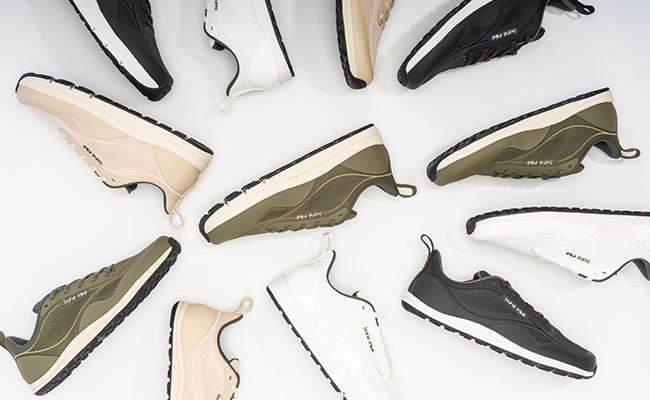
Pick up any conventional trainer and look at it from the side. Notice how the toe section curves upward, lifting off the floor even when the shoe is sitting flat? That's called toe spring, (Nigg, 2010), it's sometimes referred to as ‘toe rocker’ .
It exists partly because many conventional shoes have thick, inflexible soles that don't bend naturally with the foot (Roy & Stefanyshyn, 2006). Rather than the shoe flexing as your toes push off the ground, the toe spring pre-curves the front of the shoe to allow a rolling motion during walking and running. The result, over time, is that your toes are held in a consistently raised position, which may alter natural toe function during the gait cycle.
When we set out to design our first barefoot-style shoe, the Revive Original, removing unnecessary artificial toe spring was one of the most important decisions we made. A flexible, foot-shaped shoe doesn't need excess toe spring - the shoe can bend with the foot as nature intended. Even in Endurance, our most cushioned option, the toe spring is considerably lower than in most conventional trainers. It's a detail that rarely gets talked about, but it matters for how your toe extensors work over time.
An even more geeky detail is what happens to the thickness of the sole under the toes. Some cushioned shoes taper the sole at the front to facilitate roll-off, which may reduce toe mobility. So in our shoes we ensure the sole remains flat to the ground until close to the front. This not only allows full toe mobility during walking and running, but it also allows your toes to fully engage with the ground when standing or weight training (Kelly et al., 2014). If you're wearing our Endurance Mode, press your toes down into the ground - then try the same in almost any other cushioned shoe and you'll notice the difference.







Leave a comment