Skip to content

How to Reawaken Your Feet with More Ground Contact

Bag
0

How to Reawaken Your Feet with More Ground Contact

Your feet are built for variation. More textured surfaces and more conscious ground contact can help reawaken them by restoring better sensory input.


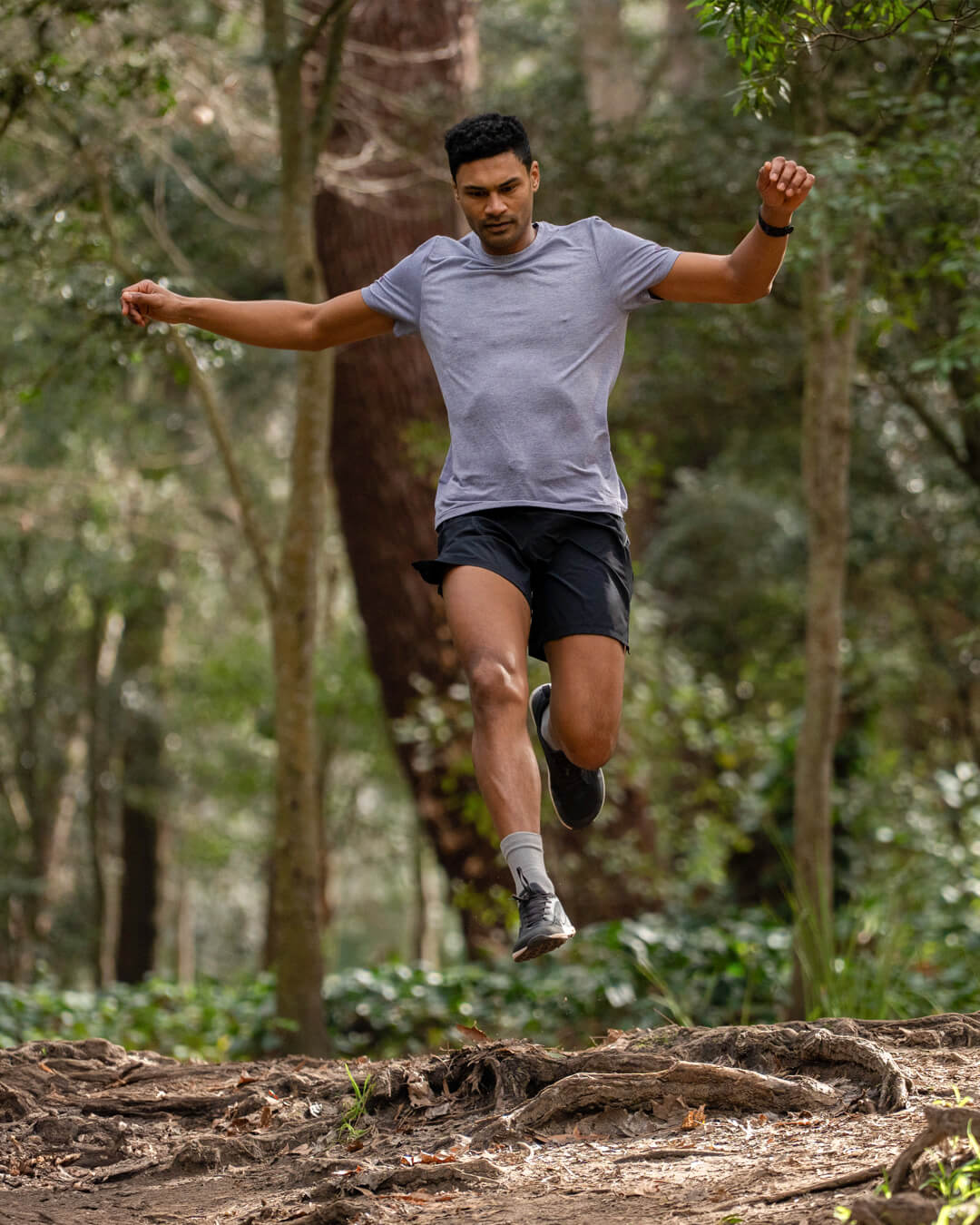
Man running through a forest on a dirt path

Your feet are extraordinary parts of your body - strong, mobile, sensitive, and built to respond to constant change. For most of human history, they would have experienced far more texture, variation, and natural feedback than most of us now get in everyday life (Lieberman et al., 2010). These days, even if you move a lot, the world often funnels you onto flat floors, smooth pavements, level roads, and repetitive surfaces that give the feet far less of the stimulation they were designed to experience.

The encouraging part is that this can be changed. Your feet are highly adaptable, and when you give them more useful input, they respond (Nigg et al., 2015). This post is part of our ground feel series, and the central idea is simple: better signals can support better movement. One of the easiest ways to improve those signals is to spend more time consciously seeking texture, variation, and contact with the ground beneath you - either barefoot where that makes sense, or in shoes that let you feel more of what is underfoot.

Your feet are built for variation

The foot has 26 bones, 33 joints, and a dense network of muscles, tendons, ligaments, and nerves all working together to help you balance, adapt, and move (Standring, 2016). It is designed to respond to change - the firmness of the ground, the texture underfoot, the angle of the surface, and the subtle differences from one step to the next.

When the ground is more varied, the feet and nervous system receive more detailed sensory information. That gives the body more to work with and helps support the small, mostly subconscious adjustments that make movement feel more responsive and well co-ordinated (Strzalkowski et al., 2018). This is one reason textured surfaces can feel so good. They wake your feet up.

Why modern life gives your feet less sensation

For most of us, varied natural terrain is no longer the default. Even if you walk a lot, much of that walking happens on surfaces that feel much the same from one step to the next. Modern footwear can add to that by reducing the feeling of texture and variation underfoot, especially when it is heavily cushioned or stiff enough to make everything feel more consistent (Robbins & Hanna, 1987).

That is why many people notice such a strong difference when they spend more time barefoot, or in shoes that let them feel the ground more clearly. The foot is suddenly receiving more information again, which can sharpen awareness, improve how you place the foot, and bring back some of the subtle responsiveness that less textured environments tend to reduce (Hatton et al., 2011).

How to reawaken your feet

The most useful shift is to start moving more consciously.

Once you begin paying attention to what is under your feet, you often realise how many opportunities are already there. Tree roots breaking through the earth. Loose stones at the side of a path. Twigs, gravel, cobbles, bumps in the pavement, and the change between smooth and rough ground, firm and soft ground, dry and damp ground. When you start seeking texture, you start spotting it everywhere.

That is where this becomes interesting. You are no longer just walking from A to B on autopilot. You are making small conscious choices to give your feet more to feel. Maybe you take the route through the park instead of the smooth pavement. Maybe you step onto the grass rather than staying on the path. Maybe you spend more time barefoot in the garden, or slow down slightly on a woodland trail and let your feet notice more.

Those small choices change the quality of the signals your feet are getting, and over time that can help walking feel more connected, more responsive, and more alive. Running in thin soled shoes on natural terrains is one of the most visceral connections you can feel with the natural world, it’s an incredibly immersive experience. Naturally if you’re new to barefoot shoes this can take some progression and you may want to start with a little more cushioning (Ridge et al., 2013), but it can be a great thing to work towards.

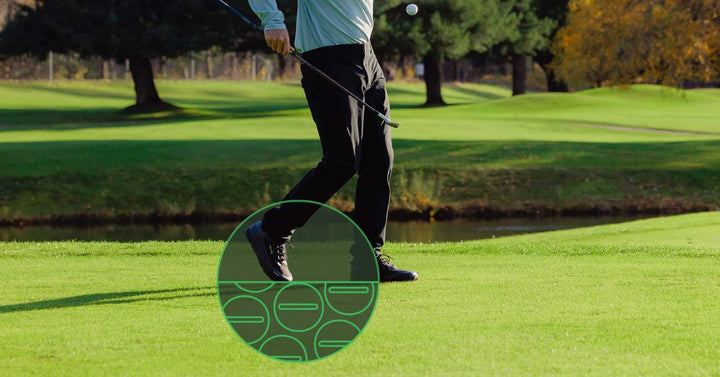
Why textured surfaces wake the feet up

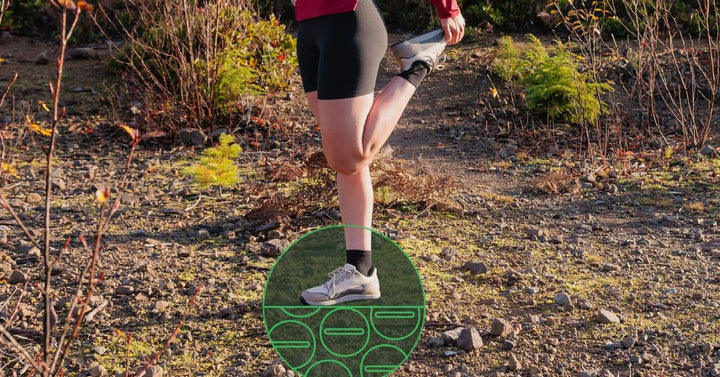
Textured and varied surfaces wake the feet up because they provide more detailed sensory feedback. The sole of the foot contains specialised receptors that detect pressure and changes in contact with the ground (Kennedy & Inglis, 2002). When the surface is more varied, those signals become more detailed and the body has more information to work with.

That can lead to better foot placement, more active movement through the foot and ankle, greater awareness of the ground beneath you, and a stronger sense of connection with each step (Meyer et al., 2004). In simple terms, more varied surfaces give your feet more to respond to, and that often makes movement feel sharper and more engaged.

Step onto natural surfaces and get grounded

Walking on natural surfaces brings another layer of benefit too. If you are barefoot on natural ground - or in conductive footwear designed for grounding - you are not only getting better sensory input through the feet, you are also electrically reconnecting with the earth (Chevalier et al., 2012). Being barefoot on natural ground or using conductive footwear allows an electrical charge to pass between yourself and the earth (Chevalier et al., 2012).

That is part of what makes time on natural terrain feel so powerful for a lot of people. You are getting movement, texture, variation, and grounding all at once.

Ready to reconnect?

When you walk more consciously, seek out texture, and choose more varied surfaces where you can, you give your feet better signals and more opportunity to do what they are built to do. That can make movement feel more responsive, more connected, and more enjoyable.

If you want the broader movement case for why this matters, read Why Feeling the Ground Helps With Balance, Control and Performance. If you want help choosing the right level of cushioning and ground feel for where you are now, take the Find Your Mode quiz.

Charlie is Head of Movement at Bahé. He blends research with lived experience to help people rebuild strong, functional feet and move with confidence - creating practical movement guidance, transition education, and simple routines people can actually stick to.

Foot strengthening exercise

Barefoot Transition Exercises

Bahé Rewild shoes on moss

Barefoot Shoes Explained

References

  1. Hatton, A.L., Dixon, J., Rome, K. and Martin, D. (2011) ‘Standing on textured surfaces: effects on standing balance in healthy older adults’, Age and Ageing, 40(3), pp. 363–368. Read the article

  2. Kennedy, P.M. and Inglis, J.T. (2002) ‘Distribution and behaviour of glabrous cutaneous receptors in the human foot sole’, The Journal of Physiology, 538(3), pp. 995–1002. Read the article.

  3. Lieberman, D.E., Venkadesan, M., Werbel, W.A., Daoud, A.I., D’Andrea, S., Davis, I.S., Mang’Eni, R.O. and Pitsiladis, Y. (2010) ‘Foot strike patterns and collision forces in habitually barefoot versus shod runners’, Nature, 463, pp. 531–535. Read the article

  4. Meyer, P.F., Oddsson, L.I.E. and De Luca, C.J. (2004) ‘Reduced plantar sensitivity alters postural responses to lateral perturbations of balance’, Experimental Brain Research, 157(4), pp. 526–536. Read the article

  5. Nigg, B.M., Vienneau, J., Smith, A.C., Trudeau, M.B., Mohr, M. and Nigg, S.R. (2015) ‘The preferred movement path paradigm: influence of running shoes on joint movement’, Medicine & Science in Sports & Exercise, 47(8), pp. 1640–1648. Read the article

  6. Chevalier, G., Sinatra, S.T., Oschman, J.L., Sokal, K. and Sokal, P. (2012) ‘Earthing: health implications of reconnecting the human body to the Earth’s surface electrons’, Journal of Environmental and Public Health, 2012, Article ID 291541. Read the article

  7. Ridge, S.T., Johnson, A.W., Mitchell, U.H., Hunter, I., Robinson, E., Rich, B.S., Brown, S.D. and Cuddeford, T. (2013) ‘Foot bone marrow edema after a 10-week transition to minimalist running shoes’, Medicine & Science in Sports & Exercise, 45(7), pp. 1363–1368. Read the article

  8. Robbins, S.E. and Hanna, A.M. (1987) ‘Running-related injury prevention through barefoot adaptations’, Medicine & Science in Sports & Exercise, 19(2), pp. 148–156. Read the article

  9. Standring, S. (ed.) (2016) Gray’s Anatomy: The Anatomical Basis of Clinical Practice. 41st edn. Elsevier. Read the article

  10. Strzalkowski, N.D.J., Peters, R.M., Inglis, J.T. and Bent, L.R. (2018) ‘Cutaneous afferent innervation of the human foot sole: what can we learn from single-unit recordings?’, Journal of Neurophysiology, 120(3), pp. 1233–1246. Read the article

Leave a comment

Please note, comments need to be approved before they are published.

Alert me via email when this size/colour becomes available